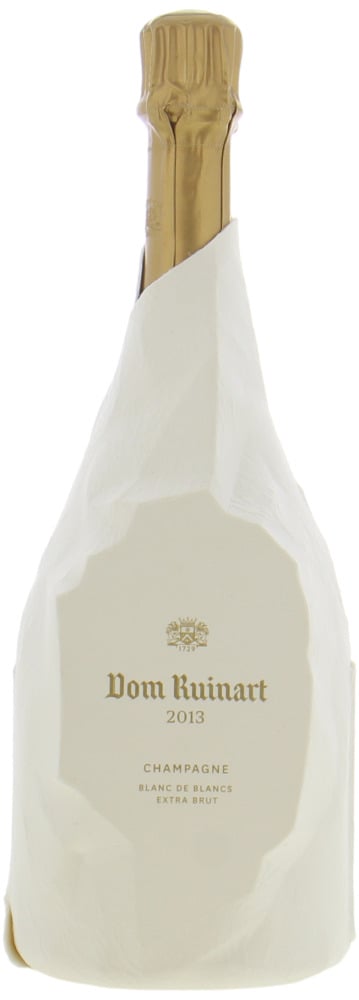
| Classification | Cru Classe |
| Type | Sparkling |
| Producer | Ruinart |
| Vintage | 2013 |
| Country | France |
| Region | Champagne |
| Grape | Chardonnay |
| Alcohol % | 12% |
| Volume | 0,75 |
| Condition | Perfect |
| Label | Perfect |
| Drinkable | -2042 |
| Stock | 4 |
The 2013 growing season in Champagne was cold and slow. The late spring delayed flowering and harvest did not begin until early October. This long, patient ripening is necessary for Chardonnay to achieve tension and transparency. Dom Ruinart 2013 reflects this. It is a classically structured Blanc de Blancs with high acidity from a harvest that rewarded growers willing to wait. Expect precision rather than richness, and long aging.
The 2013 Dom Ruinart Blanc de Blancs is another triumph from the late Frédéric Panaïotis. Disgorged in July 2023 after nine years sur lattes, with a dosage of 5.5 grams per liter—slightly higher than previous releases, tempering the brisk acidity of this cool, slow-ripening vintage—it wafts from the glass with deep aromas of fresh hazelnut, nashi pear, orange, hyacinth and bread dough, alongside the hint of Sichuan pepper and a subtle smoky note that only enhances its gently reductive, toasty signature. On the palate, it is medium- to full-bodied and chiseled, combining crystalline purity with vinosity, enlivened by a pillowy mousse and bright structuring acids, concluding with a precise, chalky finish. Expect a structurally more tightly wound version compared to the demonstrative 2009.
A graceful Champagne, with a featherweight feel on the palate and precision detailing to the fine mousse. Yet this delicate touch belies the tightly meshed flavors of poached peach, lemon curd, roasted hazelnut and canelé pastry, plus accents of ground ginger, smoke and acacia blossoms, that reveal themselves as they expand through the lasting finish.
Wonderful savory and toasty complexity. Aromas of toasted bread, mussel shells, chamomile, honey and dried citrus. It’s medium-bodied, silky and seamless, with a sharp backbone of acidity tying everything together. Reductive and intense.
Oyster-shell nose, lemon and green apple, a touch of smoke and toffee on the finish. Lingering savoury mushroom and river-pebble character – this is channelling good white burgundy, and has a few more years to go before entering its peak period.
The 2013 Dom Ruinart remains rather airy and light on its feet. Citrus peel, slate, chalk, mint and white pepper lend notable brightness throughout. This is a very pretty Dom Ruinart, but it is also not ready to drink. It remains a bit light texturally. It will be interesting to see if this fleshes out with more time in bottle. That said, the 2013 is coming along very nicely. October harvests have become exceedingly rare in Champagne. Dosage is 5.5 grams per liter. Disgorged: July 2023.
Dom Ruinart 2013 is a blanc de blancs of lithe, satin-smooth beauty already upon release, very much built around the reserved, cool energy of the 2013 vintage. This cuvée's new aromatic range, amplified since the 2010 release by toasty, spicy energy brought on by bottle fermentation under cork (sous liège), is very much at play. However, with undertones of roasting coffee, honey and fresh walnut playing with smoky gunflint and nougat richness as the gentle lemon, lime and even tropical fruit eases out with time in the glass. It's narrow rather than austere, gently sea-salt-savoury rather than lip-smackingly mineral or chalky – a Dom Ruinart with a long, long life ahead, but an equally rewarding window already opening up. Chardonnay from Le Mesnil, Avize, Chouilly, Bergères-les-Vertus, Sillery, Verzenay and Taissy, disgorged after nine years on lees.

First impressions. Aged for nearly a decade on the lees, chalky and citrus-zesty, with notes of toasted brioche. The palate is supple. Lemon zest, white flowers and notes of saltiness from the Grand Cru Chardonnay. The bubbles are fine, almost creamy. The acidity provides a long and mineral finish. This is classic Dom Ruinart style.
Dom Ruinart has always been a blanc de blancs:
So why is there no Pinot? Because Ruinart has built its identity on Chardonnay. The fruit from the Côte des Blancs brings tension and citrus, while the fruit from Montagne de Reims brings body. This contrast is key.
Drink from now until about 2042; the 2013 vintage gave Champagne unusually high acidity and this wine has the appropriate structure; store at a stable temperature of 11-13°C, ideally on its side. Over time, the citrus will give way to notes of honey, hazelnuts and toasted bread. There's no need to rush.
Ruinart is important because it was the first. Nicolas Ruinart opened his sparkling wine account book on September 1, 1729. So what has kept the house going for nearly three centuries? An unwavering commitment to Chardonnay. All of the house's cuvées are made predominantly from Chardonnay, and the prestigious Dom Ruinart line is 100% Chardonnay. Although Ruinart is now part of LVMH, the best wines are always aged at 11°C in a chalk cellar located 38 meters underground in Reims. We stock this wine because its consistency is evident in the glass.
It is the chalky soil that characterizes this wine. It is deep, pure and sometimes visible between the vines. The Champagne region lies between the 48th and 49th parallels, far enough north to allow serious viticulture here. The chalky soil drains quickly, but retains enough moisture to stabilize the vines even during dry periods. It also stores heat during the day and gives it up overnight. For Chardonnay, this means slow ripening, high natural acidity and salty minerality on the palate. It is for this reason that the Côte des Blancs is the spiritual home of this grape.
A characteristic technique is long aging. Dom Ruinart is aged on lees (dead yeast cells from secondary fermentation) for about 10 years. This allows for a layer of brioche and hazelnuts underneath the citrus. The dosage is intentionally kept low so that the chalk and acidity come to the fore rather than being softened by sugar. The 2013 was also the first vintage of Dom Ruinart in which the wine was aged under cork rather than under crown cap during secondary fermentation.
Salty minerality and high acidity. This will tell you what to put on your plate. Some suggestions:
Serve at 10-12°C. Cool enough to tighten the bubbles and warm enough to bring out the flavors.
With track & trace code