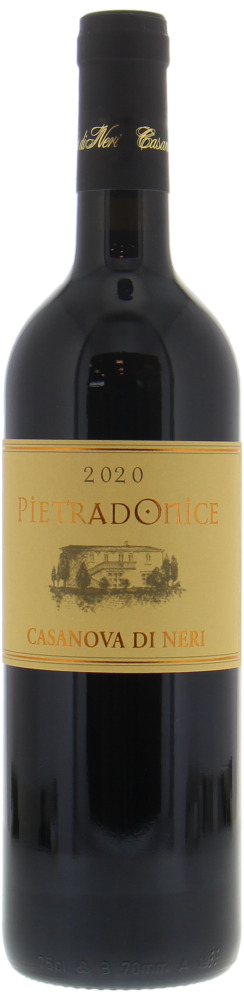

| Classification | Cru Classe |
| Type | Red |
| Producer | Casanova di Neri |
| Vintage | 2020 |
| Country | Italy |
| Region | Tuscany |
| Appellation | Bolgheri |
| Grape | Cabernet Sauvignon |
| Volume | 0,75 |
| Condition | Perfect |
| Label | Perfect |
| Drinkable | -2040 |
| Stock | 11 |
The 2020 growing season in Montalcino brought warm, dry summers and cool nights at high altitudes, and conditions suitable for Cabernet Sauvignon. For Casanova di Neri's Pietradonice IGT, this means ripe but not overcooked fruit, and acidity is well preserved thanks to the daily fluctuations in the hillside vineyards. The 2020 is definitely a Cabernet, though more elegant tart than in cooler years.
The Casanova di Neri 2020 Pietradonice holds an immense bouquet with generous cherry and dark fruit that shows a nicely ripened phase without feeling overtly mature. There is a sweet note that recalls high-end raspberry jelly, exotic spice, perfumed redwood, cypress and black olive. There is definitely no varietal greenness, and the wine delivers a firm and compact build that covers the whole palate.
Rich ruby red with slightly brightening edge suggesting some maturity. On the nose there's a discreet rum pot aroma, then earthy notes and a touch of currant and Amarena cherry. Well balanced on the palate, it's juicy, albeit with a little roughening on the finish - still needs time.
Tuscan Cabernet often shows its best in warmer years. The nose reveals graphite, cedar, dried Mediterranean herbs and faint notes of iron characteristic of the hilly soils of Casanova di Neri. The palate is full, with firm tannins, but already polished at the edges. Finishes with blackcurrant and tobacco. Drinkable now if you let it air out, but aging is recommended.
Pietradonice is a straight Cabernet Sauvignon. It uses neither Sangiovese nor Merlot, which temper it. So why exactly is it Cabernet in Brunello country? Because Casanova di Neri planted the Pietradonice vineyard specifically to see what Cabernet could do at the altitude of Montalcino. The result is a wine with the black currant and cedar notes of Cabernet, but with the savory, mineral tinge that Montalcino soils give to everything that grows there.
Drink between 2026 and 2040. Store at 12-14°C. The tannins are still firm, and the fruit is concentrated enough to last another 10 or 20 years. Over time, the blackcurrant transitions to leather and tobacco, the oak melts and the iron notes become more pronounced.
Giovanni Neri acquired Podere Casanova in 1971. The Sangiovese vines on the property needed replanting, so he started virtually from scratch. The estate now covers 63 hectares in seven vineyards, each with its own soil, sun exposure and age of vines. The flagship wine, Brunello Cerretalto, has received 100 points from several critics. Casanova di Neri is one of the most reliable wineries in Montalcino, and Pietradonice is their bet for Cabernet.
Casanova di Neri's Pietradonice vineyards are located between 200 and 450 meters above sea level. Why is altitude important? Because the Tuscan sun allows the Cabernet grapes to fully ripen the skins, and the temperature difference between day and night preserves acidity at the cool nights of high altitude. The soils on the estate are a typical Montalcino mixture with variations of sandy, calcareous, marl, clay and stone. This calcareous element gives Pietradonice a savory, almost iron note that is rarely found in Cabernet from warmer, flatter areas.
Hand-harvested, de-stemmed and fermented exclusively with indigenous yeasts, without the use of commercial strains. Stainless steel is used for fermentation and temperatures are controlled so that the warm Tuscan climate doesn't pressure the yeast and ruin the flavors. The wine is then decanted into wooden barrels. Pietradonice is aged for 37-43 months, depending on the vintage and cuvée, and then bottle aged for 6-24 months before release. This long aging period gives the Pietradonice wine its luster upon release.
Cabernet tannins call for protein and fat. Tuscan cuisine handles them with ease:
Serve at 16-18°C. Decant an hour before serving, especially in 2020.
With track & trace code