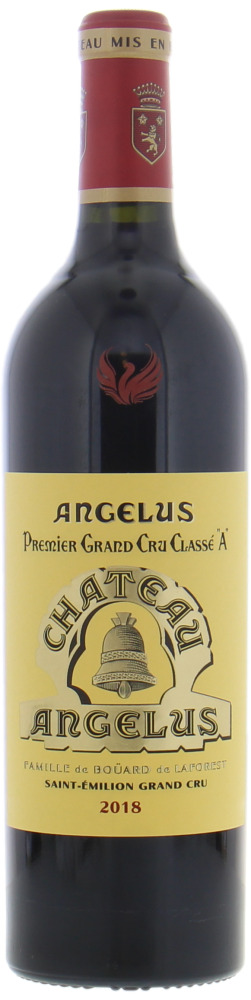
| Classification | Premier Grand Cru Classe A |
| Type | Red |
| Producer | Chateau Angelus |
| Vintage | 2018 |
| Country | France |
| Main region | Bordeaux |
| Region | Saint-Emilion |
| Grape | Merlot, Cabernet Franc, Bordeaux Blend |
| Alcohol % | 14.5% |
| Volume | 0,75 |
| Condition | Perfect |
| Label | Perfect |
| Drinkable | 2026-2048 |
| Stock | 4 |
The conditions in Saint-Émilion in 2018 were ideal: warm days, cool nights and enough rain to keep the vines healthy. For Château Angélus, located on the coveted south-facing slope, this meant perfect ripening of Merlot and Cabernet Franc and outstanding concentration. The farm's transition to organic farming, which began the same year, added further complexity to an already exceptional vintage. Critics, including Robert Parker and Jancis Robinson, took notice of the wines and praised their balance of power and elegance. 2018 was one of the standout years for Angélus under the guidance of terroir specialist and Stéphanie de Boüard-Rivoal. She believes that this vintage reflected both the evolution of the estate and the exceptional terroir.
The 2018 Angélus is blended of 65% Merlot and 35% Cabernet Franc, aged mainly in oak barriques, 100% new, plus two new foudres. Deep garnet-purple in color, it struts flamboyantly out of the glass with stylish scents of black raspberries, boysenberries and Black Forest cake, plus nuances of rose oil, forest floor, dusty soil and cinnamon toast with a hint of cedar chest. The medium to full-bodied palate is carrying a little new oak at this youthful stage, framing the generous red and black fruits along with ripe, plush grape-skin tannins and seamless freshness, finishing long and spicy. Give it 5-6 years in cellar for everything to marry, then drink it over the next 20+ years.
Sweet tobacco and black olives with some basil and terra cotta. Violets and dark berries, too. Very fine and linear with freshness and beauty. Full and very tight with beautiful depth. It goes on for a very long time.
Tasted blind. Big, bold, very ripe. Sweet and charming with some floral notes. Really glossy and fun. Lifted and lively. Even though not the most concentrated. A little bit of heat on the end. (JR)
The 2018 Angélus is striking. Cabernet Franc aromatics make a strong first impression. Vibrant and delineated, the 2018 is incredibly refined in every way. The move towards a bit less extraction really seems to let the purity of the fruit come through. The same is true of a reduction of oak. All the elements come together so effortlessly. The 2018 has all the richness readers expect of Angélus, with much more finesse and more overall vibrancy, a combination that works so well.
I loved the 2018 Château Angélus from barrel last year and it blew me away from bottle, epitomizing the new, fresher, more elegant style of the estate while still bringing classic Angélus richness and power. The 2018 is a blend of 65% Merlot and 35% Cabernet Franc that was brought up in new oak, with a portion of the Cabernet Franc in foudre. A vivid purple color is followed by a vibrant bouquet of blackberries, crème de cassis, crushed violets, spring flowers, and cedar pencil. Beautifully concentrated, full-bodied, and flawlessly balanced on the palate, it has gorgeous tannins, remarkable purity of fruit, and awesome length. I followed this bottle for multiple days and it only improved, picking up additional depth and richness, while never showing a hint of oxidation. Pure perfection, it's going to benefit from 7-8 years of bottle age and keep for 3-4 decades. This is a sensational, magical wine from this talented team, led by winemaker Emmanuelle d'Aligny-Fulchi. Comparing this to the more opulent 2005 and 2009 over the coming decades will be an incredible experience.
Dark cherry and black currant flavors from the Merlot and distinctive violet tones and pencil sharpening from the Cabernet Franc. There is also a chalky minerality due to the limestone soils. In the mouth, the wine is dense but not heavy, with tannins that don't cling. The finish feels characteristically Angélus floral, almost exotic flavors. Skeleton. This wine has the structure to age gracefully for decades; the 2018 wine is in fine shape now, but deserves patience.
This blend perfectly reflects the terroir of Angélus:
But why does Cabernet Franc play such an important role? The sandy clay-limestone soils at the foot of the slopes are ideal for Cabernet Franc, and older vines can produce surprisingly concentrated fruit despite relatively low yields. It is the Cabernet Franc that gives Angélus its characteristic flavor, more structured and complex than typical Right Bank wines, which are dominated by Merlot alone.
Best aging time: 2028-2045, but could be longer. Due to the age of the Cabernet Franc vines, the tannin structure is firm but balanced, with enough acidity to keep the wine fresh. Store patiently at cellar temperature (12-15°C). With time, expect the fruit to become more complex, tertiary notes of truffle, leather and forest floor to emerge, and floral elements to become more pronounced.
The de Boüard de Lafollet family has shaped the estate since 1782, but it was the modernization of Hubert de Boüard at the end of the 20th century that transformed Angélus into what it is today. In 2012, Angélus was classified as Premier Grand Cru Classé A, joining the three other top-ranked Saint-Emilion vineyards in the region. The estate was then classified as a Premier Grand Cru Classé A, joining the other three estates at the pinnacle of Saint-Emilion's classification. What sets Angelus apart, however, is that it voluntarily relinquished that title in 2022. We at industry observers believe that this decision is truly a sign of confidence in their ability to produce great wines.
Angelus is located in what locals call a natural amphitheater on the southern slopes of Saint-Emilion. This position concentrates the summer heat and promotes early ripening. The soil is divided into two zones: the upper zone is clay-limestone, which grows Merlot, and the lower zone is sandy clay-limestone, which grows Cabernet Franc. Why is this important? Clay retains moisture during droughts, so the vines are not stressed even in hot summers like those of the 2020s. And the underlying limestone provides a mineral backbone that can be felt in every bottle. The slopes are always well drained, which is essential to prevent waterlogging during the rainy season.
Angelus is characterized by the use of open tanks for fermentation, a method pioneered by Hubert de Boüard in the 1990s. This allows for better extraction while maintaining the elegance that is essential for blends with a high Cabernet Franc content. After fermentation, the wine is aged on its lees to give it texture without masking the fruit. In recent vintages, the use of larger oak barrels in addition to traditional barriques (small French oak barrels) has softened the heavy oak notes of earlier vintages. The result is a fresher, more transparent wine, which is exactly what we see in this 2020 vintage.
Protein is needed to soften the hard tannins in the wine, which explains why Bordeaux and beef have been partners for centuries. Try Côte de Beef with shallot confit. The fat of the beef softens the tannins and the minerality of the wine breaks up the richness. Duck breast would also work well with a cherry sauce, especially in response to the dark fruitiness of the wine. If you want to try something more regional, try herb-fried rabbit, served at 16-18°C and decanted for at least an hour to allow the flavors to develop.
With track & trace code