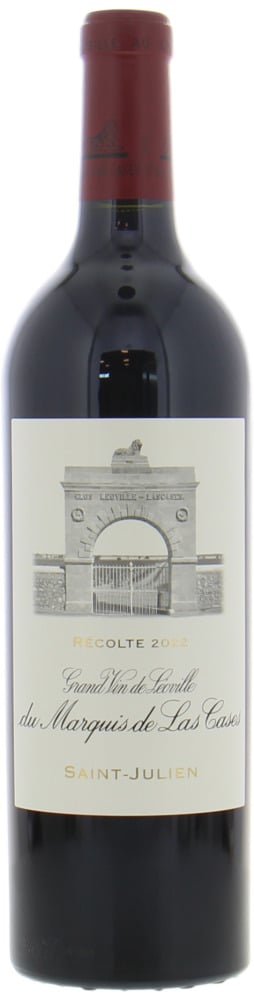
| Classification | Cru Classe |
| Type | Red |
| Producer | Chateau Leoville Las Cases |
| Vintage | 2022 |
| Country | France |
| Main region | Bordeaux |
| Region | Saint-Julien |
| Grape | Cabernet Sauvignon, Merlot, Bordeaux Blend |
| Alcohol % | 14% |
| Volume | 0,75 |
| Condition | Perfect |
| Label | Perfect |
| Drinkable | 2035-2065 |
| Stock | 6 |
The 2022 harvest at Château Léoville Las Cases was shaped by an extreme season, with hot and dry conditions followed by decisive rains late in the season. Jean-Hubert Doron and his team waited until early October to harvest, allowing the Cabernet Sauvignon to reach phenolic ripeness. This patience is evident in the glass. This wine combines the elegance and exceptional concentration characteristic of Saint-Julien, and many consider it a modern classic from this second-growth estate.
The 2022 Léoville Las Cases is just as remarkable in bottle as it was from barrel. Wafting from the glass with aromas of beautifully pure cassis fruit mingled with notions of violets, burning embers and subtle cigar box, it has already almost entirely integrated its new oak. Full-bodied, dense and layered, it's deep and resonant, with striking concentration, precision and harmony, concluding with a long, palate-staining finish. This striking Saint-Julien really is one of the wines of the vintage, and the best young Léoville Las Cases I've ever tasted.
Sophistication and pure beauty on the nose, showing intense lead pencil, blackcurrants, ink and blackberries as well as crushed stones. Spellbinding. Medium-bodied, it grows endlessly on the palate, superb tannins caressing like the finest silk. It just keeps on coming. The character is immaculate. Ethereal. Power with elegance. 83.5% cabernet sauvignon, 10.5% cabernet franc and 6% merlot. It gives the impression you can drink it now, but it needs five to six years of bottle age. A neoclassical masterpiece. Try after 2031, but if you want to taste it now, I understand.
83.5% Cabernet Sauvignon, 10.5% Cabernet Franc, 6% Merlot. Cask sample.
Deep crimson colour. Complex, powerful and refined with blackcurrant, violet, spice and cedar notes. Juicy and dense with layered fruit and tannins. Big structure but the tannins almost hidden. Picks up pace on the finish. Long. One of the top wines this year. (JL)
The nascent 2022 Léoville Las-Cases, matured in 85% new oak, instantly makes an impression and vindicates my rhapsodizing from barrel. Intense yet boasting exquisite delineation, the aromatics are endowed with immense depth, retaining those estuarine nuances, hints of blue fruit, fig and crushed violets. The palate is medium-bodied with svelte tannins. Stunningly balanced and poised, satin-like in texture yet with ample backbone and grip to guarantee longevity, this ranks amongst the best Grand Vins that I have tasted from Jean-Hubert Delon's Saint-Julien estate. This flirts with perfection.
A monumental wine, the 2022 Château Léoville Las Cases is seriously dense and powerful, with a locked and loaded nose of cassis, crushed stone, graphite, and remarkable mineral intensity. Focused and structured on the palate as well as full-bodied, it has fine tannins and sensational purity. The 2022 is based on 84% Cabernet Sauvignon, 10% Cabernet Franc and 6% Merlot, brought up in a mix of new and used oak. Hide bottles for 10-15 years and it should drink beautifully over the following 40-50 years.
Both Parker and Suckling gave this wine a perfect score of 100 points. Where does this enthusiasm come from? The nose shows layers of blackcurrant and graphite - typical Saint-Julien markers, but with even more density. Cassis notes dominate, backed by cedar and tobacco notes that emerged after 18 months of aging in French oak barrels. The tannins are refined yet firm. This is not an austere Cabernet from a cool year - the 2022 is immediately striking - but it clearly has decades ahead of it.
Cabernet Sauvignon predominates here, with the percentage usually around 65% in Leoville Las Cases. This percentage reflects the estate's gravelly soils, which drain well and warm the Cabernet to full ripeness. Merlot makes up about 19% of the blend, adding fleshiness to the middle of the palate. Cabernet Franc makes up 16% of the blend, higher than other Left Bank farmers. What matters is this: This percentage of franc gives the wine an aromatic lift, helps it age, and contributes to the violet and spice notes that set Las Cases apart from its Pauillac neighbors.
For those who prefer the intensity of a young Bordeaux, this wine is drinkable now, but patience is recommended. Perfect drinking will begin around 2030 and last until 2050. Why wait? This 100-point rating indicates that the wine is suitable for long aging. Cabernet Sauvignon provides the backbone and Merlot lends richness to the middle of the palate. This vintage has the right conditions for aging.
Jean-Hubert Delon is the latest generation of the family that has been building this estate since 1900 on a foundation laid in 1638. But what makes the Delon family stand out? Their willingness to sacrifice quantity for quality. In difficult vintages, they have been known to downgrade up to 67% of the harvest. This no-compromise approach explains why Las Cases is consistently rated among the top second growths. Best of Wine considers this estate to be one of the most reliable producers in Bordeaux.
The 55-hectare Grand Clos vineyard is located right next to Château Latour. Only a small stream separates these two legendary estates. This proximity is no accident. Both estates share the same deep Gunz gravel soils overlying a clay-limestone subsoil deposited during the Pleistocene period. So what makes Las Cases different? Its prime southeastern location brings optimal morning sun while avoiding the intense midday heat. These well-drained gravel soils store heat during the day and release it at night, allowing for a longer growing season and allowing the Cabernet Sauvignon to fully ripen even in difficult years.
The Delon family has kept the tradition alive while adding modern touches. Fermentation takes place in temperature-controlled stainless steel and concrete tanks to preserve the purity of the fruit before it goes into barrels. Important decisions are made after malolactic fermentation, the wine is aged in French oak barriques for 18-20 months. This may sound aggressive, but the Grand Clos vineyard produces fruit with enough concentration for this. The result? We end up with the layered, complex flavors that Saint-Julien is known for, with notes of cedar and tobacco along with black currants.
Tannins require protein, which is why Côtes de Boeuf is so well suited to this wine. Beef fat softens the wine's structure, and the iron-rich meat responds to the terroir. Roasted duck breast with cherry gastrique is a perfect bridge between the wine's fruitiness and its earthy notes. Of the cheeses, choose a mature Comté or Roquefort. The salty and umami flavors balance the wine's intensity; serve at 16-18 °C and decant for at least an hour. The wine will show patience at the table as well as in the cellar.
With track & trace code