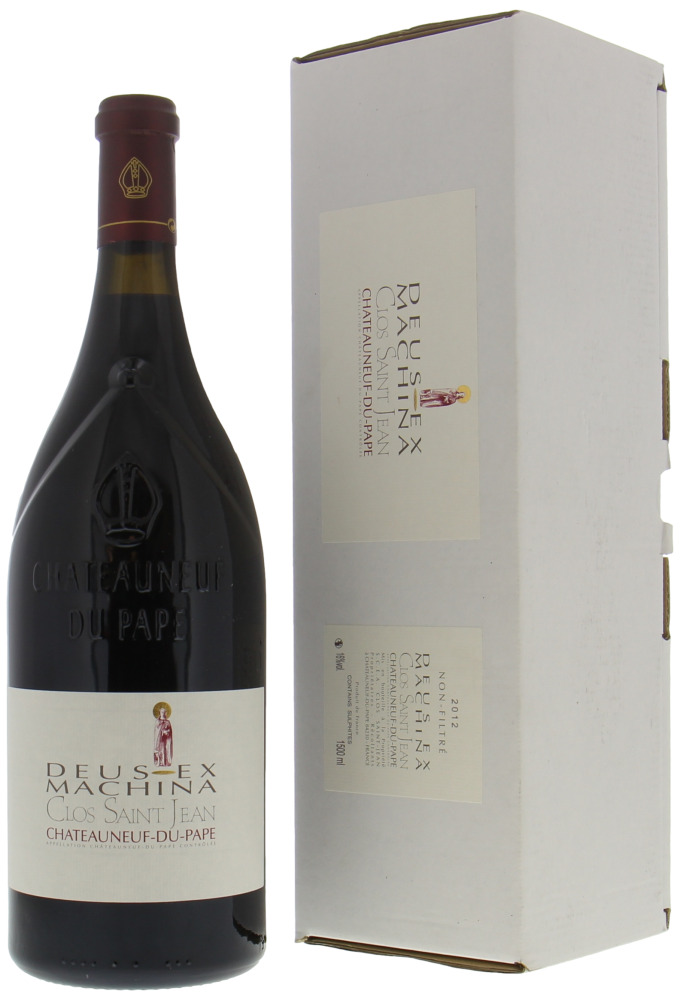

| ex Vat | € 269,00 |
| in Vat | € 325,49 |
| Volume | Magnum |
| Classification | Cru Classe |
| Type | Red |
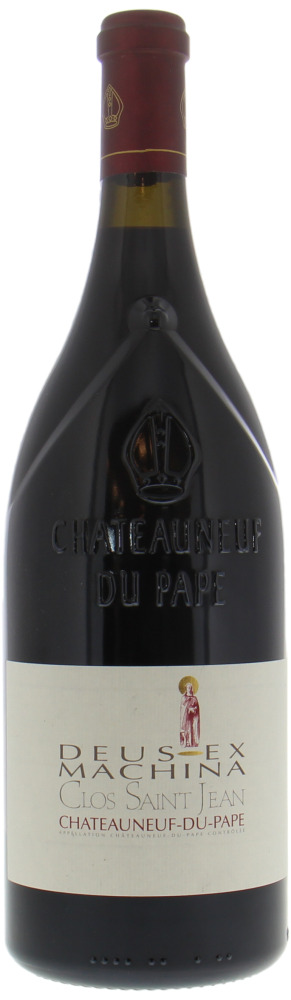
| Producer | Clos Saint Jean |
| Vintage | 2012 |
| Country | France |
| Region | Rhone |
| Appellation | Châteauneuf-du-Pape |
| Grape | Grenache, Mourvedre |
| Alcohol % | 16% |
| Volume | 1,5 |
| Condition | Perfect |
| Label | Perfect |
| Drinkable | -2034 |
| Stock | 3 |
| Volume | 1,5 |
| Condition | Perfect |
| Label | Slightly damaged back label |
| Drinkable | -2034 |
| Stock | 1 |
The 2012 growing season at Châteauneuf-du-Pape began with cool and wet weather. Coulure (poor flowering) led to a sharp decline in the Grenache crop, but those varieties that survived ripened slowly and evenly. The 2012 Deus Ex Machina from Clos Saint Jean was smaller, more concentrated and fresher than the broad-shouldered 2010 and sunny 2009. Classic Châteauneuf shape.
The 2012 Châteauneuf du Pape Deus Ex Machina is a blend of 60% Grenache aged in foudre (from close to 100-year-old vines) and 40% Mourvedre aged in demi-muids. Its deep ruby/purple color is followed by incredible notes of cassis, roasted meats, licorice, toasted spice and a liquid rock-like minerality. Full-bodied, massive and concentrated, yet also seamless, elegant and incredibly polished, it flows onto the palate with building tannin, no hard edges and perfect balance. I wouldn’t be surprised to see this merit a perfect rating in the future, and it should hit prime-time drinking around age 10, and have 20-25 years of overall longevity. It’s one of the few wines to hit this level of quality in the vintage.
Big but deftly balanced, with tiers of fig, blackberry, black currant and plum fruit supported by baker's chocolate, maduro tobacco, pepper, bay leaf and roasted alder notes. The intense finish lingers.
60% Grenache, 40% Mourvèdre. 12 months in 60% concrete tanks, 40% barriques.
Crimson. Extremely sweet start and then some freshness. Dense and rich. Very satisfying on the finish. Extremely ambitious and it works – so long as you don't mind your red wine reminding you very strongly of port! Some heat on the finish.
Pouring the 2012 Deus Ex Machina, the first thing you notice is the mourvedre. Wild herbs, crushed olives, hints of garrigue and something savory, almost meaty. Then there's an old vine Grenache with notes of kirsch, raspberry liqueur and warm stone. The flavor is dense but not heavy. The tannins are firm and fine-grained, framed by the acidity of the 2012. Long peppery finish. Drinkable with air, but still firm.
The blend is approx.
The proportion of Mourvedre is high for Chateauneuf, in most blends it does not exceed 20%. So why exactly is Mourvedre used? Grenache brings sweetness, alcohol and red fruits. Mourvèdre pulls in the other direction: structure, dark spices and a savory note.
Deus ex Machina 2012 should be drunk from now until about 2035. Mourvèdre's tannins are still powerful, and the acidity of this cool vintage gives it a longer finish than the 2009 or 2010; store at 12-14°C. With aging, notes of kirsch move into leather, truffle and dried herbs.
Until 2002, Clos Saint Jean was a quiet family estate. It was then that brothers Pascal and Vincent Maurel became its owners and invited oenologist Philippe Cambie to join them. The changes were drastic. Yields were reduced, harvesting was delayed, fruit selection was intensified, and suddenly Clos Saint-Jean was on par with the best wines of the appellation. The vines themselves are no secret. But it took Maurel and Cambie to transform this terroir into the Deus Ex Machina wine. We consider them one of the most consistent modern producers in the Southern Rhône.
La Crau is a plateau east of Châteauneuf-du-Pape where the Deus Ex Machina Grenache grows. The surface is covered with galets roulés (quartzite pebbles polished by the ancient Rhone). Underneath is red soil and sand. Why it's important. The pebbles absorb heat during the day and release it at night, allowing the thick-skinned Grenache to fully ripen. The red soil retains moisture, so old vines don't shut down even in hot summers. Mourvèdre is grown in the adjacent sandy sector, which gives it more lift and aromatic detail.
This separation is intentional. Grenache is fermented and aged in concrete tanks, oak is not used. Why. The concrete preserves the purity of the fruit and allows the Grenache to show its raspberry and spice notes without the interference of vanilla. Mourvedre, on the other hand, is aged in barriques and 600-liter demi-muids. The aging period is approximately 12 months. The grapes are hand-picked and the growing methods are organic. No new oak is used and no additives are used.
This wine makes you want some fat and herbs. Taste:
Mourvèdre needs fat and protein to balance its tannins. Serve at 16-17°C and decant for at least an hour. Older bottles require less air.
With track & trace code