
| Classification | Cru Classe |
| Type | White |
| Producer | Gaja |
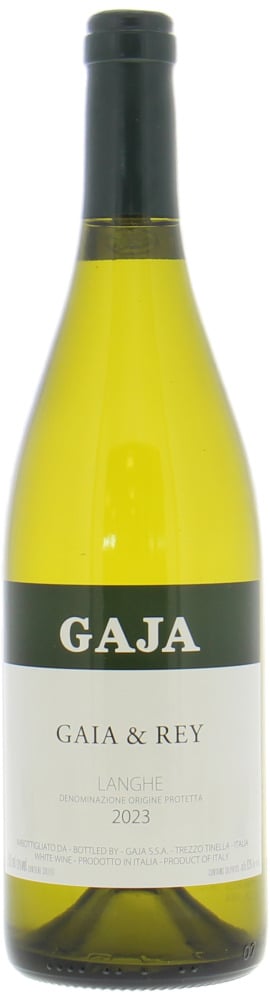
| Wine | Gaia & Rey |
| Vintage | 2023 |
| Country | Italy |
| Region | Piemonte |
| Grape | Chardonnay |
| Alcohol % | 13% |
| Volume | 0,75 |
| Condition | Perfect |
| Label | Perfect |
| Drinkable | -2040 |
| Stock | 10 |
The 2023 growing season in Langhe was wet and challenging, with spring rains fraying the nerves of grape growers before warmer, drier weather settled in late summer. For Gaja's Treiso vineyard, this meant careful selection and relatively early harvesting of white grapes. The result is Gaia & Rey 2023, a wine with bright tension and dense flavors. It is less flamboyant and more restrained than in warmer years. Review by BOW
First impressions. Lift. Gaia & Rey 2023 opens with white peach, lemon zest and a shimmer of matchsticks, with French oak (barriques, small 225-liter barrels) at the bottom rather than the top. The flavor is supple, almost salty, with green apple and toasted hazelnut in the mid-palate. The acidity is spine-tingling. The finish is long, with soft butter and minerals. Will age in bottle for another year or two before popping the cork.
Parsing is simple:
100% Chardonnay from the Rey vineyard in Treiso.
Why it matters. Treiso is located in one of the highest and coolest communes of the Barbaresco zone, and thanks to the altitude (about 350-400 meters above sea level), acidity is well preserved even in warm harvests. The Chardonnay here is more like Burgundy than California Chardonnay. This is exactly what Angelo Gaja was aiming for when he planted this vineyard in 1979.
Drink between 2026 and 2035. Gaia & Rey 2023 has enough acidity and oak structure to age, but it's not a wine that needs 10 years; it will likely be approachable in its third or fourth year; store at 12-14°C, on its side, away from light; it should stay in the cellar for at least 10 years.
Ask a wine merchant which Italian producer has become the most important in the last 50 years. The answer will be immediate: Gaja. Angelo Gaja took over the company in 1961 and did what no one had done before him at Barbaresco. Temperature-controlled stainless steel. French Barrique. A bottling of single vineyard wine; in 1979 he also planted Chardonnay, which his neighbors thought was crazy. Today, his children Gaia, Rossana and Giovanni are responsible for the day-to-day management of the business. Best of Wines offers Gaja's wines, whose consistency from vintage to vintage is unrivaled.
The Rey vineyard is located in Treiso, one of the highest communes in the Barbaresco zone, at about 350 meters above sea level. Why is altitude important for Chardonnay? Cool nights. The climate in Piedmont is continental, with hot summer days, but at Treiso altitude the temperature drops sharply after sunset, preserving acidity in the grapes that would otherwise be reduced in warmer climates. The soil is calcareous marl from the Tortonian, the same bluish-gray marl that gives the best Langhe wines tension and length.
The decisive choice here is barrel work. Gaja ferments Gaia & Rey in French oak barriques and then ages it for several months in the same wood until malolactic fermentation is complete (turning the pungent malic acid into soft lactic acid and imparting creaminess). Why barriques and not steel? Angelo wanted not only fruitiness, but also texture and length. The barrels, however, are not the screaming, vanilla-soaked California style of the 1980s. The new oak is restrained enough to allow Treiso's fruit and acidity to still drive the wine. It is this balance that is key.
This wine has body and a firm oak backbone, so it needs food that can stand up to it. Try it:
Serve at 11-13°C. The flavors fade when too cold, and become heavy when too warm.
With track & trace code