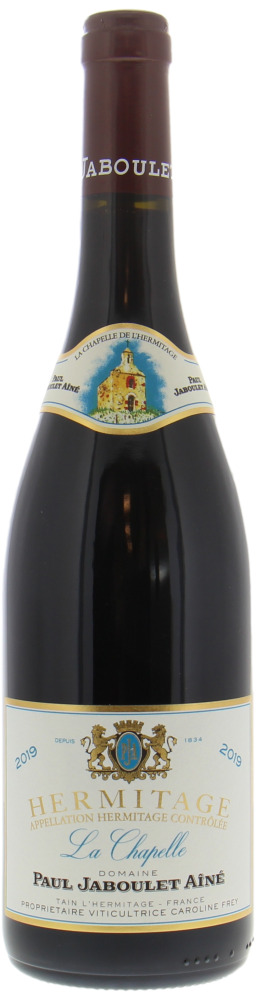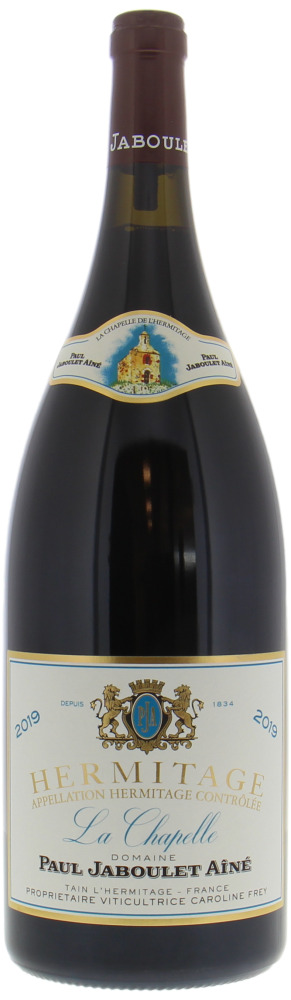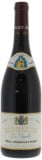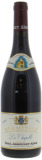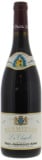

| ex Vat | € 449,00 |
| in Vat | € 543,29 |
| Volume | Magnum |
| Classification | Cru Classe |
| Type | Red |
| Producer | Paul Jaboulet Aîné |
| Vintage | 2019 |
| Country | France |
| Region | Rhone |
| Appellation | Hermitage |
| Grape | Syrah/Shiraz |
| Volume | 0,75 |
| Condition | Perfect |
| Label | Perfect |
| Drinkable | -2042 |
| Stock | 9 |
| Volume | 1,5 |
| Condition | Perfect |
| Label | Perfect |
| Drinkable | -2036 |
| Stock | 2 |
The 2019 growing season in the Northern Rhône was hot and dry, with sustained warmth leading to an early, concentrated syrah harvest from the Hermitage Hills. For Paul Jaboulet Aîné's La Chapelle winery, this meant that the grapes from the Les Bessards and Le Méal lieux-dits were fully ripe without losing their crispness. The resulting grapes are powerful but not heavy and show the delicate hand of Caroline Frey.
Last year, I giddily speculated whether the 2019 Hermitage La Chapelle would warrant a 100-point score. While close—and I wouldn't completely discount it reaching that pinnacle in another decade or two—I'm not sure this wine is as good as I thought. It boasts exciting aromas of roasted meat, mocha, crushed stone, plum and cassis on the nose. It's full-bodied, concentrated, richly tannic and velvety in texture. It's long and complex on the finish, adding hints of cracked pepper and salted licorice. And yet, as much as I enjoyed tasting it and as undeniably great it is, angels didn't sing from the heavens. Maybe next bottle.
Rich, intense and exotic, this boasts racy peach, orange zest, acacia, nectarine and tangerine notes at the core, while white ginger, green tea and bitter grapefruit fill the finish. A lovely minerality courses underneath, showing impressive length.
Very dark in colour. A bouquet at the intersection of fresh fruit (wild blueberry), spicy (menthol, black pepper and juniper), ripe fruit (black cherry and raisin), with a little wood. On the palate, the wine has a maximum of the finest tannins; despite its immense density, the wine has no astringency whatsoever. The acidity and tactile minerality hold together the sweet, full, oily body, yet somehow it seems weightless and delicate. Very, very long.
The first impression is dark and savory. Black olives, smoked bacon, crushed blackberries and the graphite notes that Hermitage is known for. The flavor is dense but not jammy, with firm tannins, fine-grained and very long. The finish is elegant, with notes of violets. Drinkable now after a long decant, but this 2019 will be more interesting in five years.
La Chapelle is 100% syrah. Hermitage rules allow up to 15% Marsanne or Roussanne in red wine, but Jaboulet doesn't go that far. So why Syrah specifically? Because the mixed granite soils of Les Bessards and Le Méal already give the wine the flavor and structure it needs. Adding white grapes would soften this uncompromising wine, but Jaboulet prefers its pure power.
This wine rewards cellaring. It can be drunk from 2027 to 2050, and the most appropriate period is from 2028 to 2042. The tannins still need time to integrate and the fruit is concentrated enough to drink well for decades. Storage: 12-14°C, on its side, away from light. Patience required.
Jaboulet has been working on Hermitage Hill since 1834, and his 1961 La Chapelle is still considered one of the greatest wines of the 20th century. But after Gerard Jaboulet's death in 1997, quality declined. What changed: in 2006, the Frey family bought the estate and Caroline Frey took over the winemaking. She rebuilt the cellar, converted the vineyards to organic and biodynamic farming, and re-focused on the wines. 2010 onward is the strongest vintage for La Chapelle in decades.
The Hermitage is a single hill. It faces south, has a total area of 137 hectares and rises dramatically above the Rhone River at Tain-l'Hermitage. Why is granite important? Decomposed granite drains well and retains heat, allowing Syrah to ripen in the northern latitudes of the Rhone. The climate here is continental with Mediterranean influences, and the mistral winds dry the canopy and reduce disease. La Chapelle's vineyards are harvested between 150 and 300 meters above sea level, where the topsoil varies between granitic sand, glacial pebbles and clayey limestone.
Under Caroline Frey, restraint is an important consideration. The grapes are mostly de-stemmed, a departure from the old tradition of whole bunches and resulting in cleaner fruit and softer tannins. Fermentation takes place under gravity in a cellar rebuilt in 2010. Aging in French oak is approximately 12 months, with the percentage of new oak limited to 20-30%. Why it matters. With less new oak, Les Bessards' unique granitic character is not drowned out by vanilla and toast, but becomes distinctly tangible.
Syrah from the Northern Rhône loves game and char. Try venison tenderloin with pepper jus and the black pepper notes inherent in this wine will double. Braised wild boar and Provençal-style pigeon match the tannins. Aged Comté or Beaufort will be suitable as a base for a cheese course if served at 17°C and decanted at least two hours before in the case of young bottles.
With track & trace code