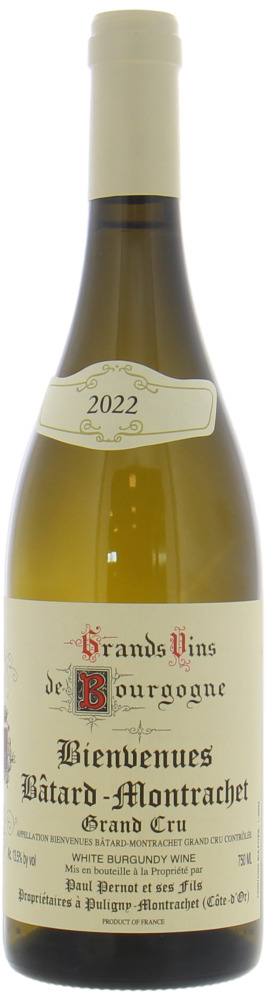

| Classification | Grand Cru |
| Type | White |
| Producer | Paul Pernot |
| Vintage | 2022 |
| Country | France |
| Main region | Burgundy |
| Region | Côte de Beaune |
| Appellation | Bienvenue-Bâtard-Montrachet |
| Grape | Chardonnay |
| Alcohol % | 13.5% |
| Volume | 0,75 |
| Condition | Perfect |
| Label | Perfect |
| Drinkable | -2040 |
| Stock | 3 |
The 2022 growing season at Puligny-Montrachet was warm and dry, and harvest was pushed back to late August. After a frost-affected 2021, yields have finally returned to normal levels. For Paul Pernot's Bienvenue Batard Montrachet wine, this year brought ripe Chardonnay with remarkably preserved acidity. This combination is rare in hot vintages. Expect the 2022 wine to be more fleshy than in previous years, but with the tension and exuberance characteristic of Puligny.
As is often the case chez Pernot, the nose closely resembles that of the Pucelles with perhaps just a bit more overall floral influence. By contrast, there is slightly more volume as well as slightly better power and mid-palate density to the bigger-bodied if still elegant and refined flavors that display outstanding length on the complex, balanced and harmonious finale that is just a bit more structured.
Pale colour with a lime tint. The bouquet indicates some power but no detail, as yet. Lush white fruit with a slightly honeyed note, continues well across the palate, a little toast and just enough acidity. The aftertaste continues quite well, while showing the riper aspects.
First impressions are of honeyed white peaches, lemon curd, notes of crushed hazelnuts and chalky flavors typical of Bienvenue. On the palate, the 2022 shows the warmth of the vintage. The texture is weighty, almost creamy, but the acidity keeps everything in balance. The finish is long and salty, with white flower aromas separating Bienvenue from its larger neighbor, Batard. If you drink it too quickly, you will miss the moment. It needs airing or time.
100% Chardonnay. So why does Bienvenues-Bâtard-Montrachet handle a warm year like 2022 better than one might expect? The vineyard sits on Bathonian limestone mixed with marl, which is less rocky than neighboring Batard, and the soil is slightly cooler and retains water better. The Chardonnay here ripens fully without losing its acidity. This combination is the reason why the 2022 wine remains fresh.
Drink between 2027 and 2040; 2022 is distinctive in acidity and concentration and is suitable for aging, but white Grand Cru wines from warmer vintages are best aged in bottle for at least five years. Store in the cellar at 12-14°C. Opened too early, it shows fruitiness but lacks complexity.
The Pernot family has owned the land at Puligny-Montrachet for over 200 years, but it wasn't until 1959 that Paul Pernot officially established the estate. So why don't we hear more about it? All because the domaine is quietly sold to negociants such as Joseph Drouhin, and the family avoids publicity. Nevertheless, along with Domaine Leflaive and Domaine Sauzet, Paul Pernot is one of the three largest landowners in the village. The combination of size and modesty makes this wine truly underrated.
Bienvenues-Bâtard-Montrachet is the smallest Grand Cru on Montrachet Hill, north of Bâtard and east of Le Montrachet. The vineyard is 240-250 meters above sea level, on Bathonian limestone with brown marl, and less rocky than Bâtard. Why it matters. Less rock means slightly deeper soils, which means the wines are more fleshy and less raw and powerful. Bienvenues is closer in style to Puligny, more finesse than power, more chalky than rich.
Pernot's approach is deliberately hands-off. Whole-cluster pressing, indigenous yeasts, barrel fermentation. The proportion of new oak is limited to 25%, even in Grands Crus, and the barrels are lightly toasted so that the wood doesn't overshadow the story. Stirring of the lees (batonage) is minimized during fermentation and completely stopped during aging. Why so restrained? Because Bienvenues already has structure. Pernot's task is not to interfere.
Such a Grand Cru needs a cuisine that respects it, not competes with it. Think about it:
Serve at 12-14°C. Too cold a wine weakens the flavors. Open 30 minutes before pouring.
With track & trace code