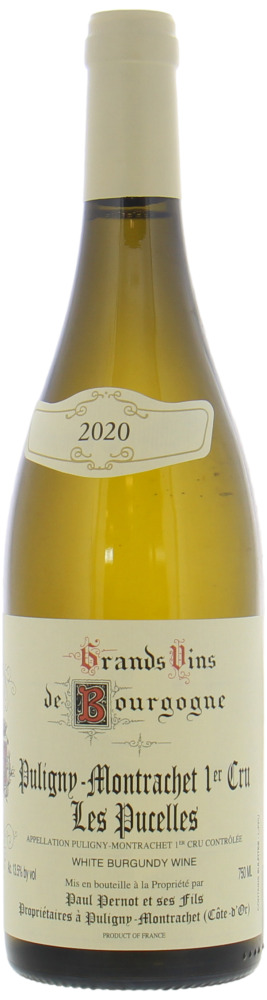

| Classification | Premier Cru Classe |
| Type | White |
| Producer | Paul Pernot |
| Vintage | 2020 |
| Country | France |
| Main region | Burgundy |
| Region | Côte de Beaune |
| Appellation | Puligny-Montrachet |
| Grape | Chardonnay |
| Alcohol % | 13.5% |
| Volume | 0,75 |
| Condition | Perfect |
| Label | Perfect |
| Drinkable | -2036 |
| Stock | 3 |
The 2020 growing season in Burgundy was hot and dry, with harvest beginning in mid to late August. For Paul Pernot's Les Pucelles, this meant smaller berries, lower yields and more concentrated juice. But many Puligny-Montrachet producers were surprised by the freshness that survived the heat: expect the 2020 wine to be denser than the 2017 and 2018 vintages, but in the broad, rich style typical of Les Pucelles.
Offering up aromas of pear, orange oil, baking spices, green apple and pastry cream, the 2020 Puligny-Montrachet 1er Cru Les Pucelles is medium to full-bodied, ample and satiny, with a giving, open-knit profile and a nicely defined, saline finish.
A slightly more elegant nose expresses aromas of honeysuckle, passion fruit, Asian style tea and cool essence of poached pear wisps. The caressing and highly seductive medium-bodied flavors possess a wonderfully sophisticated mouthfeel while delivering absolutely superb length on the balanced finale that has that element of 'presence'. Lovely juice with fine development potential.
Clear light bright colour. A nose with some distinction but not much exuberance. A little fruit ripeness then starts to emerge, with a little sucrosity behind, icing sugar on white fruit. Enough acidity, but I am missing the nobility of this potentially great vineyard
The first impression is ripeness. White peaches, pears, notes of yellow apple, acacia flowers and a typical Puligny chalky note. On the palate, the 2020 wine shows the broader, fleshier side of Les Pucelles (this cru sits on deep soils adjacent to Bâtard-Montrachet), but the saline tension runs through the mid-palate, keeping it in focus. The finish is long and slightly nutty, beginning to hint at honeyed notes that will emerge with age.
Drink no earlier than 2026 or until 2036, possibly longer. The warm harvest concentration gives this wine power, and the acidity (more than many feared in 2020) gives it structure. 12-14°C, store horizontally away from light.
Most people are familiar with Domaine Leflaive. Less well known is that Paul Pernot is one of the three main landowners of Puligny-Montrachet, along with Leflaive and Sauzet, owning some 23 hectares. So why is he so little known? The Pernot family does not seek publicity. The family has owned land in the region for over 200 years, and Paul founded the estate in 1959 with 10 hectares. He is now the third generation, with his sons Michel and Paul Jr. handling the day-to-day operations. According to Best of Wine, Pernot offers the best priced Premier Cru level wine in the village.
Les Pucelles is a fortunate neighbor. It is located on the mid-slopes of Puligny-Montrachet and is in direct contact with the southern Grand Cru, Bâtard-Montrachet. This is very important. The soils here are deeper than on the upper slopes of Premier Cru such as Les Folatières, with more clay mixed with active limestone. Deeper soils mean that the wines retain more water, flesh and body. Add to this the cool continental climate of the Côte de Beaune and you get wines with the breadth of Bâtard and linear elegance for which Puligny is famous.
Paul Pernot's principle is restraint. The use of new oak is limited to 25% and the barrels are deliberately lightly toasted. After whole-cluster pressing and fermentation in barrel, the wine is aged on fine lees. Bâtonnage (stirring of the lees to impart texture) is minimized during fermentation and completely discontinued during aging. Why? Because the Pernot family wants Les Pucelles to taste like Les Pucelles, not the winemaker's signature. This is why the estate is highly trusted by those who are committed to tradition.
A Premier Cru Puligny like this needs a lot of richness on the plate. Try this:
Serve at 12-14°C. Does not require decanting, but the cork should be removed 30 minutes before serving.
With track & trace code