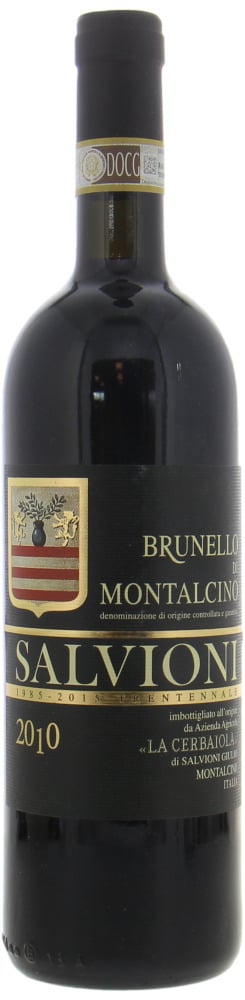

| Classification | Cru Classe |
| Type | Red |
| Producer | Salvioni |
| Vintage | 2010 |
| Country | Italy |
| Region | Tuscany |
| Appellation | Brunello di Montalcino |
| Grape | Sangiovese |
| Volume | 0,75 |
| Condition | Perfect |
| Label | Perfect |
| Drinkable | -2040 |
| Stock | 2 |
Montalcino's 2010 harvest was cool and late. The Brunello di Montalcino Grape Consortium gave this wine 5 stars, and rightly so. For Salvioni La Cerbaiola, a winery located at 420 meters above sea level in the northeast, these conditions make for a well-structured Brunello, with more freshness and tension to be expected than in warmer years such as 2009 and 2011.
Salvioni makes stunning wines that appeal to die-hard Brunello fanatics. The 2010 Brunello di Montalcino La Cerbaiole shows enormous purity, varietal personality and beautifully balanced intensity. The wine hits all of your senses at once. The bouquet offers red cherry, licorice, dried rosemary, ginger and cola. You taste the most elegant, delicate and ethereal notes that can be extracted from Sangiovese. The tannins are super fine and the texture is silky and supple. This is an iconic wine.
Shimmering, bright ruby. Very fragrant, finely drawn nose with notes of ripe red cherry, watermelon, cinchona bark and cranberry: extremely exciting. Straightforward and clear on the palate, flows calmly – here beautiful, juicy fruit, there fine-meshed tannin and also some texture, everything in the right place. Does not seem too exciting at first, only on the second sip does depth and elegance become apparent. Long finish.
The first sensation is the perfume. Dark cherry, dried rose, leather, a whisper of tobacco leaf and the iron-like nuances that Sangiovese from the eastern slopes of Montalcino usually exudes. On the palate, the Salvioni 2010 is dense but with classic galestro tension lurking beneath the fruit. The tannins are still firm and almost chewy. The acidity keeps things tight. This is a Brunello made for longevity, not for tonight.
Only one grape variety is allowed for Brunello di Montalcino DOCG:
Sangiovese (a clone of Sangiovese Grosso), known as Brunello.
So why does Salvioni's version taste so different from, say, Banfi or Casanova di Neri? Location. La Cerbaiola is on the outskirts of Montalcino, 420 meters above sea level, on the galestro (crumbly, schist-like marl). It is cool at night and has good drainage. This gives this Sangiovese an aromatic lift and grip.
Drink between 2025 and 2040; the 2010 vintage was awarded five stars by the Consortium, and Salvioni made this wine to last. The tannins are still firm; store horizontally at 12-14°C and decant an hour before serving.
Salvioni is a small company: just four hectares of vineyards on a 20-hectare estate, and only two wines come out of the cellar. So why has it become iconic? Because La Cerbaiola tops the list of authentic Brunello wines, along with Biondi Santi, Soldera and Cerbaiona. The story began when Giulio Salvioni bottled the first commercial vintage in 1985. Today, the business is run by his children, Alessia and David. Wine critics consider Salvioni one of the few Brunello producers who truly live up to expectations.
La Cerbaiola is located about 4 km northeast of Montalcino, 420 meters above sea level, with three small plots facing east. The soil is a typical Tuscan duplex consisting of a mixture of calcareous shale, stony marl and gravelly shale. Why is it so important? There are two reasons. The high altitude provides cool nights, which helps preserve the acidity and flavors of Sangiovese even in warmer areas. Also, the limestone-rich, well-drained soils put stress on the vines and allow the fruit to concentrate without baking. This tension between ripeness and freshness defines Salvioni's style.
Salvioni works the vineyards by hand, pruning is strictly controlled, and yields are kept low at around 25-35 quintals per hectare. Fermentation and maceration take place in 40-hectoliter stainless steel tanks, with no temperature manipulation or extraction tricks. The wine is then placed in large Slavonian oak barrels (traditional 18-22 hectoliters) and aged for at least 36 months. Why large oak barrels? To allow the wine to breathe and integrate without adding vanilla or coconut notes. You taste Sangiovese and vineyard flavors, not oak flavors.
Acidity and tannins are the driving force behind this wine. Some of the most effective:
Served at 17-18°C. Decant young bottles one hour before serving.
With track & trace code