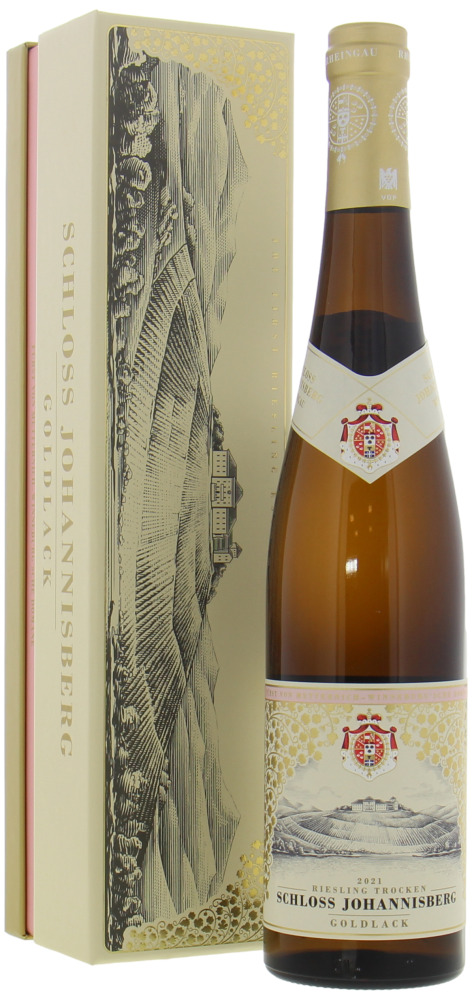
| Classification | Cru Classe |
| Type | White |
| Producer | Schloss Johannisberger |
| Vintage | 2021 |
| Country | Germany |
| Region | Rheingau |
| Grape | Riesling |
| Alcohol % | 13% |
| Volume | 0,75 |
| Condition | Perfect |
| Label | Perfect |
| Drinkable | 2030-2055 |
| Stock | 4 |
The 2021 growing season in Rheingau was cool, late and patient. The wine matured slowly, with high natural acidity and moderate alcohol content. Schloss Johannisberg's Goldlack Trocken 2021 is a dry Riesling with more tension and precision than weight. This vintage from the southern slopes of the Rheingau will appeal to those who prefer nervy, structured Rieslings. And the 2021 delivers just that.
Sourced in the south/southwest-exposed lieux-dits Urban-Wingert, Langenberg and Mäuerchen Quer and sold exclusively via the Place de Bordeaux, the intensely yellow-colored 2021 Schloss Johannisberg Goldlack Riesling Trocken (not the GG Silberlack) represents the qualitative top of the dry Rieslings of the winery. After the manual harvest of the berries during the first nine days of October and after 48 hours of maceration, the must was gently pressed and fermented in 1,200-liter oak stücks made from the family's own forest and a few smaller barrels. The wine matured for 24 months on the fine lees in the nine-meter-deep Bibliotheca Subterranea cellar at 10.5 degrees Celsius before being bottled in February 2024. Coming from a cooler and rainier year, the 2021 offers a deep, pure, intense and elegant nose of ripe yellow fruits but also black and blue berries intertwined with yeasty and flinty notes and nuances of heath and mint. Full-bodied, intense and saline on the palate, this is a distinctively ripe and juicy as well as mineral, very elegant and savory, intense and seriously structured dry Riesling with a very long, complex and aromatic as well as finely tannic and lemon-bitter finish. It has remarkable acidity (of 8.2 grams per liter). 13% stated alcohol. Natural cork. Tasted in early July and again at the domaine at the end of August 2024. The wine will be available from 21 October of this year, and it is best served in a wide Burgundy or Bordeaux glass, where its intensity is even more intensified and its texture significantly smoother.
Prepare yourself to meet the spirit of great mineral dry riesling. Gigantic dried peach and dried pear notes, but even more flinty character. A wealth of dried herbs, too. Immense concentration of stony minerality that washes over you like a great wave. Matured for two and a half years in 1,200-liter used oak cases, the last year in the deepest and oldest section of the cellar. Drink or hold.
The 2021 Riesling Schloss Johannisberg Goldlack is Johannsiberg's wine positioned above the GG. Made in limited quantity, it spent 30 months in wood. The merest touch of beeswax appears initially, almost with a hint of speculoos biscuit spice on the nose. The palate is a marvel, absolutely fluid in texture and slender but with absolute concentration. this has density but no weight. Texturally, this is different from other Rieslings, calmer and quieter, but with no less intent or direction. On the contrary, it conquers quietly but completely. The malolactic fermentation delivers a mellow finish that is deceptive, since the final acidity in this dry wine still reached an exciting 8.2 g/L. (Bone-dry)
Spontaneous fermentation spice, apple, candied citrus peel, wood, already wonderfully open. The palate is characterised by the wood maturation, yeast still noticeable, densely woven, citrus aromas, peach, juicy, grippy, high-quality phenolics, concentrated acidity, intense mineral background, fine wine.

What are your first impressions? Yellow apple, white peach, a squeeze of lime and the wet stone notes that Riesling from the Rheingau is so famous for. The palate is dry and focused, with bright acidity. There is a sense of quartzite minerality underneath the fruit. The finish is long and salty, without sweetness. Best enjoyed not as an aperitif but lightly chilled at around 10-12°C with food. A true dry Riesling.
Riesling, and nothing else. All the wines from Schloss Johannisberg are produced on the same south-facing monopole around the castle, where exclusively Riesling has been grown since 1720. So why is this so important in this case? Because the 2021 Goldlack Trocken is the purest expression of one grape on one slope. The cool weather enhances the Riesling's natural acidity and the Taunus quartzite gives the wine a mineral backbone.
Drink sometime between 2030 and 2055: the 2021 vintage gives Riesling two essential elements for aging: high acidity and unctuous concentration. Bottles should be stored horizontally at 10-14°C. Over the next decade, the initial citrus and fruit aromas will slowly evolve into honey, beeswax and classic petrol notes.
Why Schloss Johannisberg is something else: In 1720, Riesling was first planted here in monoculture; 294,000 vines were planted all along the south-facing hills above the Rhine. This decision determined the fate of German wine. In addition, in 1775 this estate accidentally introduced the Spätlese style to the world. Today, the estate is part of the Dr. Oetker Group, directed by Stefan Doktor. Schloss Johannisberg is regularly featured in the world's leading wine magazines.
The vineyard sits on Taunus quartzite schist, which is rocky, mineral rich, well drained and retains heat. Why is this important? Because riesling on warm, well-drained stones matures without losing its nerve. The slopes face south, the altitude ranges from 114 to 182 meters above sea level, in some places the gradient reaches 45%. The hills of Taunus shelter it from the cold north winds. The wide, lake-like Rhine River reflects the sun's rays onto the vineyards and mitigates temperature fluctuations. The area is a UNESCO World Heritage Site.
A decisive feature of Schloss Johannisberger is the cellar itself. Fermentation takes place partly in stainless steel and partly in large traditional oak barrels from the estate's own forests. Small barriques and heavy new oak barrels are not used. This is why Goldlack Trocken tastes of fruit and stone fruit rather than vanilla. Aging takes place in an underground vaulted cellar that was built by a Benedictine abbey around 1100. The bottle library holds wines dating back to 1748. History is part of the process here.
This wine has a heaviness and sharp acidity, so it should be paired with rich or spicy dishes. Some ideas:
Serve at 10-12°C. No need to decant, but let it rest for 10 minutes in the glass.
With track & trace code