
| Classification | Cru Classe |
| Type | White |
| Producer | Schloss Johannisberger |
| Vintage | 2022 |
| Country | Germany |
| Region | Rheingau |
| Grape | Riesling |
| Alcohol % | 12.5% |
| Volume | 0,75 |
| Condition | Perfect |
| Label | Perfect |
| Drinkable | 2030-2060 |
| Stock | 22 |
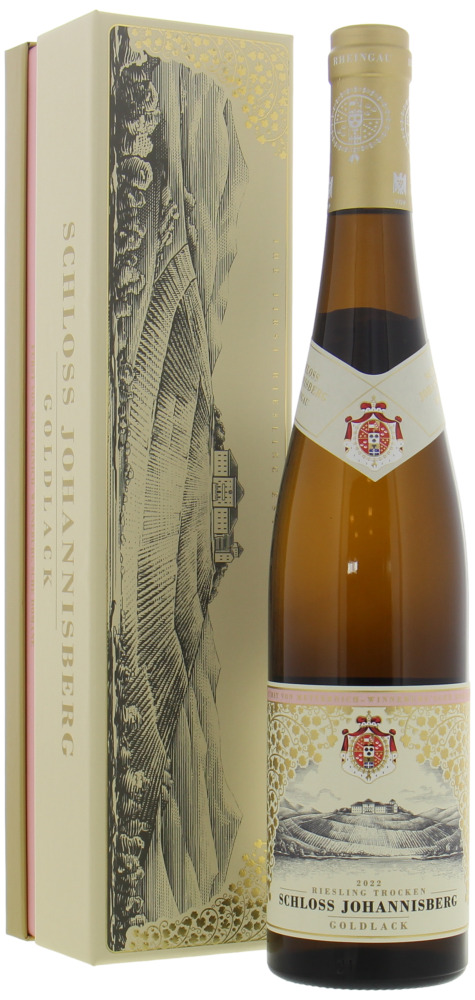
The 2022 growing season in Rheingau was hot and dry. Drought, early ripening and low yields. For Schloss Johannisberger, this meant that the grapes for Riesling arrived in the cellar with concentrated sugar content and a ripeness worthy of the Goldlack designation. The result is a dry Riesling of generous, ripe, dazzling fruit grounded in the quartzite of the Johannisberger hills. It is more fleshy than the average Rheingau Trocken.
For a vintage that was so challenging, because it was so hot and so dry, this has an amazing, flinty vitality and super-dense apricot, apricot-skin and mirabelle-plum flavors on the very focused, medium-bodied palate. Then a huge wave of stone minerality hits you but, after it has passed, the finish is as still as a mountain lake. From organically grown grapes with Fair'n Green certification. Almost limitless aging potential.
The 2022 Riesling Schloss Johannisberg Goldlack is a dry wine to sit above the GG with extended aging on lees in the lowest, coolest part of the historic cellar. It has a shimmering golden hue and projects a supple, smooth coolness. A bigger glass and more air underline an ethereal lift of cooling chamomile and white flowers. The palate unfolds like cashmere, tender and weighty, yet not bearing down. Everything here is united. Rich yeast is merely creamy and lemony. All of this is slenderness, absolute calmness and vivid length. The 2022 is a different kind of Riesling that needs time and will reward it. (Bone-dry)
Dense and still closed on the nose, smoke, white peach, crisp apricot, white grapefruit, kumquat, orange zest, chervil. Powerful and dense on the palate, finely nuanced with compact, concentrated extract, characterised by minerality, grippy, linear acidity and a fine tannin structure, tense, long.
First impression: dense; the nose of the 2022 Goldlack Trocken pushes ripe yellow peach, candied quince and a light note of honey, but is never sweet. There are stony, almost smoky nuances due to the quartzite soil. On the palate, the wine is broad and full, but the acidity shows up late and compresses everything. Finishes with beeswax and bitter almonds. Drink it now or wait. You can enjoy both.
Riesling, the only grape variety grown at Schloss Johannisberg since 1720.
Why a varietal wine? Because the hills of Johannisberg were the first vineyards in the world planted exclusively with Riesling. All bottles from this estate are single varietal, from a single vineyard: in hot years like 2022, the natural acidity of Riesling protects dry wines from heaviness. And the Goldlack tiers use particularly ripe fruit, which is why the wines have such great weight.
Drink between 2030 and 2060. Rheingau Rieslings from warm vintages often age 3-5 years before secondary aromas (honey, petrol, dried herbs) begin to emerge. Store horizontally at 10-13°C. Young bottles will be fresher, older bottles will be fuller and more aromatic.
Why Schloss Johannisberg is something else: In 1720, Riesling was first planted here in monoculture; 294,000 vines were planted all along the south-facing hills above the Rhine. This decision determined the fate of German wine. In addition, in 1775 this estate accidentally introduced the Spätlese style to the world. Today, the estate is part of the Dr. Oetker Group, directed by Stefan Doktor. Schloss Johannisberg is regularly featured in the world's leading wine magazines.
The vineyard sits on Taunus quartzite schist, which is rocky, mineral rich, well drained and retains heat. Why is this important? Because riesling on warm, well-drained stones matures without losing its nerve. The slopes face south, the altitude ranges from 114 to 182 meters above sea level, in some places the gradient reaches 45%. The hills of Taunus shelter it from the cold north winds. The wide, lake-like Rhine River reflects the sun's rays onto the vineyards and mitigates temperature fluctuations. The area is a UNESCO World Heritage Site.
A decisive feature of Schloss Johannisberger is the cellar itself. Fermentation takes place partly in stainless steel and partly in large traditional oak barrels from the estate's own forests. Small barriques and heavy new oak barrels are not used. This is why Goldlack Trocken tastes of fruit and stone fruit rather than vanilla. Aging takes place in an underground vaulted cellar that was built by a Benedictine abbey around 1100. The bottle library holds wines dating back to 1748. History is part of the process here.
This wine has a heaviness and sharp acidity, so it should be paired with rich or spicy dishes. Some ideas:
Serve at 10-12°C. No need to decant, but let it rest for 10 minutes in the glass.
With track & trace code